
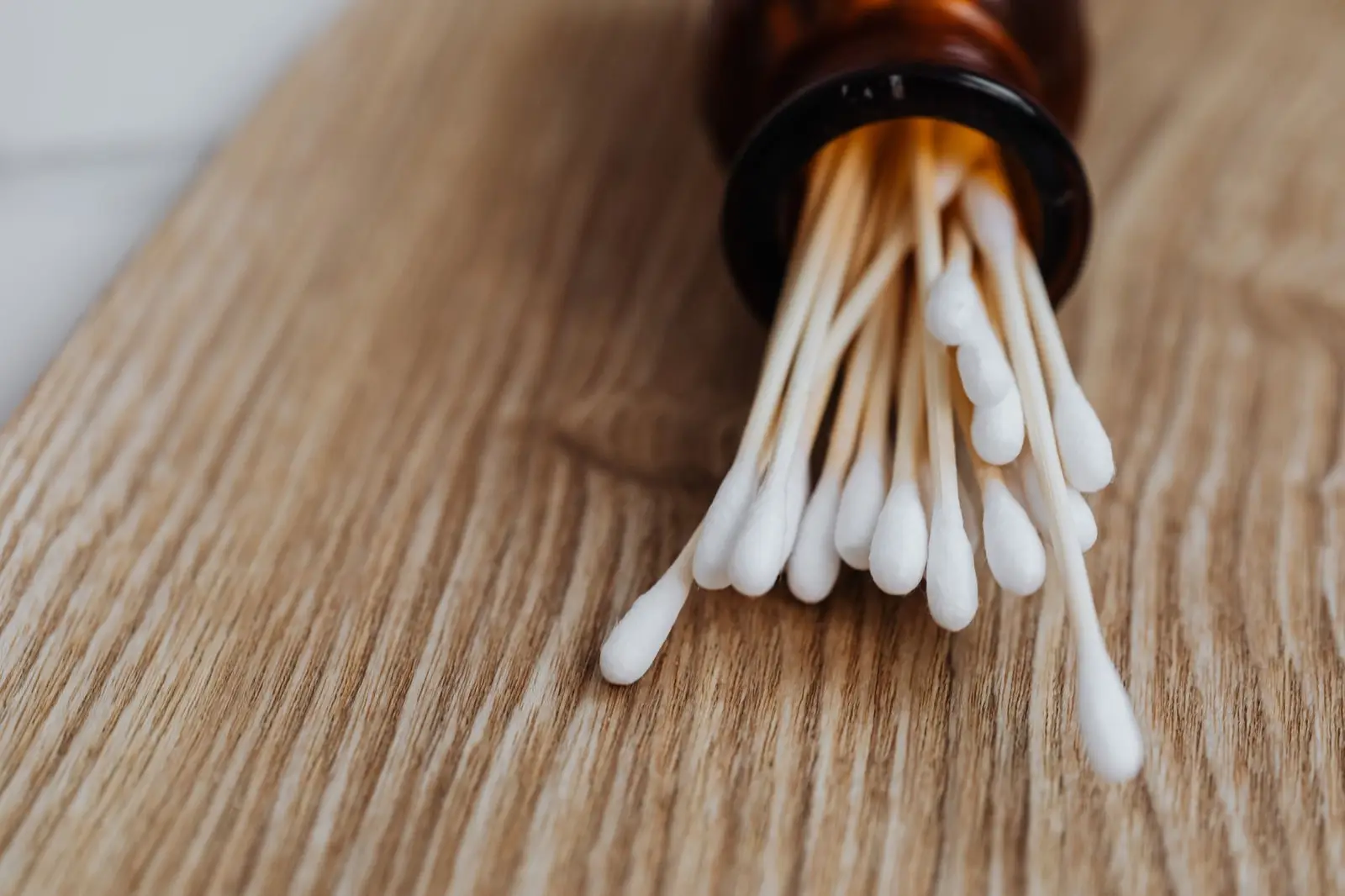
A good share of the impacted wax we see was not there until somebody tried to remove it. That is not a criticism of the people in the chair — the advice is everywhere, it feels productive, and the immediate result is a swab with wax on it, which looks like success. The problem is what happened to the wax that did not come out.
What a cotton swab does to an ear canal
The ear canal is roughly the diameter of a pencil, and a cotton swab is roughly the diameter of a pencil. It fits the way a plunger fits a drain. Some wax comes out on the tip; the rest gets pressed inward, past the narrow section, into the deeper part of the canal that the self-cleaning mechanism does not reach.
Do that a few times and you have built a dense plug against the eardrum out of wax that would have left on its own. It is now harder to remove than it ever would have been, because it has been compacted.
The second problem is injury. The skin of the canal is thin and sits directly on bone in the inner portion, and it scratches easily. A scratched canal itches, and scratching it feels like it helps, which is how people end up in a loop. Perforated eardrums from cotton swabs are uncommon but they are not rare, and they are entirely avoidable.
Ear candling does not work, and it burns people
The claim is that a hollow cone burned at one end creates suction that draws wax out. It does not. The residue found inside a used candle after burning is candle wax and ash — the same residue appears when a candle is burned without an ear anywhere near it, which is a straightforward thing to demonstrate.
The US Food and Drug Administration treats ear candles as medical devices, holds a standing import alert detaining them at the border, and states plainly that there is no validated scientific evidence they work and that they are dangerous used as labelled — a lit flame beside the face carrying a high risk of severe burns and ear damage. There is no upside to weigh against that.
The ones that are merely useless
Ear vacuums sold online do not generate meaningful suction at the pressures they operate at, and their rigid tips are an injury risk. Hydrogen peroxide is not dangerous in the short term, but used repeatedly it dries and irritates the canal, and it will not shift an impacted plug on its own.
Olive oil and pharmacy softening drops are a different case — they have a genuine role. They soften wax so it can leave on its own or be removed easily, and for mild accumulation a few days of drops can be the whole treatment. What they do not do is clear an established impaction on their own.
- Cotton swabs — compact wax inward and scratch the canal
- Ear candles — no suction, documented burns and perforations
- Ear vacuums — ineffective at the pressures they reach, rigid tip
- Repeated hydrogen peroxide — dries and irritates the canal lining
- Softening drops — genuinely useful for mild wax, not for an impaction
What to do instead
If there are no symptoms, nothing. If an ear feels mildly full, softening drops for a few days are reasonable and often enough. If the ear is genuinely blocked, if hearing has dropped, or if the drops have not worked, that is the point to have it looked at rather than escalating at home.
Removal under direct view takes minutes and is not uncomfortable when it is done properly. The whole reason it is worth coming in is that someone can see what they are doing — which is precisely what is missing when you are working blind with a swab.
Never put anything in your ear if you have a perforated eardrum, ear tubes, a history of ear surgery, or an active infection. Mention any of these when you book.
References
This article is general information about hearing health, not a diagnosis or treatment advice for any individual. Ear symptoms vary in cause and urgency — if something has changed in your hearing, have it assessed.